"The S is for surveillance": fighting KOSA and bad internet bills in the ATmosphere and the fediverses (UPDATED)
Part 2 of The Time Is Right: shifting from theory to practice.

Originally written August 3. Updated August 12, with after-action reflections.
"It's a surveillance bill. The s is for surveillance"
– Anthony Moser (author of The Kirby Frame), discussing KOSA in the ATmosphere, August 1
"If we organize, the ATmosphere and the fediverses can have a big impact in the linked fights against different aspects of the surveillance-industrial complex. The density of people here who care about these issues is high, and we've got some very useful community-controlled infrastructure, innovative technology, and a developer ecosystem that understands the value of providing tools for organizers and communities.
– The time is right: Organizing against the surveillance-industrial complex in the ATmosphere and the fediverses, July 29
The first post in this series kept things at a fairly high level. Now, let's shift from theory to practice, and focus on a very specific battle against the surveillance-industrial complex: the Senate Commerce Committee 'markup' this Wednesday, and two bills in particular:
- KOSA (the Kids Online Surveillance Act, officially known as S.1748).
- Sen. Mike Lee's SCREEN Act age verification bill (S. 737).
There's a lot of context here ... which I'm mostly going to skip over in this post; see KOSA, the KIDS Act, AI, Bad Internet Bills, and a potential giveaway to big tech and Semble collections like Fighting Bad Internet Bills and Bee's Age Verification and ID Checks for the details. The TL;DR summary is: they're bad. As Evan Greer of Fight for the Future says
"It’s important to understand “age verification” and “kick the kids off social media” laws as a gift to Big Tech. These policies allow surveillance capitalism to chug along full steam ahead and let Silicon Valley giants off the hook."
Big Tech likes to frame these as "child safety" bills but think about it for a second. As Moser points out, "OpenAI makes software that encourages kids to harm themselves, X runs a CSAM generator. They are not motivated by kids safety, they just want more data on everyone." And these bills are especially bad for trans and queer youth – see Age-Verification Laws Seek to Erase LGBTQ+ Identity from the Internet and Why Are Some Democrats Backing MAGA’s Anti-LGBTQ+ Censorship? for more on this perspective.
Unfortunately, the false claims by Big Tech and their anti-LGBTQIA2S+ allies that these bills will "protect the children" and "hold Big Tech accountable" are very persuasive. In 2024, the Senate passed an earlier version of KOSA 91-3. Strong pushback blocked it then, but now they're giving it another try.
What can the ATmosphere and fediverses do to help stop them?
A few ideas to start with:
- Turn up the volume: more calls and emails to the Senate
- Get the word out in the ATmosphere and the fediverses (and everywhere else too)
- Find a way that works for you to follow the ongoing battles over KOSA and other bad internet bills
- Experiment with different tactics
Update, August 12: I've included an update in each section, and added a new after-action reflections section at the end.
Turn up the volume: more calls and emails to the Senate
"Spirited grassroots activism stoped KOSA and other bad internet bills from passing in 2022 and 2024, and if we keep the pressure up we have a good chance to do it again. One key ingredient: getting as many people as possible to contact Congress repeatedly. Waves of phone calls and emails complements the work advocacy groups are doing behind the scenes, and gives ammunition to the politicians and staffers who are on our side."
– Tips for contacting Congress about bad internet bills
At Wednesday's markup, the committee will discuss and vote on the bills and potential amendments. Even if the committee votes to advance one or more of the bills (which they probably will), there will be other chances to block them. Still, that'll only happen if we keep the pressure up. The more noise we make around this battle, the more likely it is that they'll decide not to prioritize these bills over the rest of the year. And the more strength we can build with our organizing over the next few days, the better our position will be for whatever showdowns happen later in the session and next year.
Social networks are great for getting the word out about upcoming votes on important bills. Within a few hours of the announcement of the KOSA markup I saw dozens of posts with links to Bad Internet Bills and actions from groups like EFF, Defending Online Privacy, and 5Calls A lot of people in the ATmosphere and fediverses really do care passionately about this issue.
That said, when I look at the number of actions taken via Bad Internet Bills, it's only increased by about 500 over the last few days. Of course, there are lots of other ways for people to contact their Senators, so the number of calls and emails is higher than that, but still .... There are literally millions of people in the US with accounts on decentralized social networks. Over the next few days we should be able to contribute thousands, maybe even tens of thousands of calls and emails.
If you're reading this and you're in the US, that means you! Please contact your Senators ASAP – even if you've already contacted them about these bills.
Update, August 12: the most likely next step is a Senate floor vote, so even though the markup is over, it's still useful to contact your Senators!
A few good options here:
- EFF's Tell the Senate: Don't Turn the Internet Into an ID Checkpoint makes it easy to send a message covering KOSA, the SCREEN Act, the CHATBOT Act, and the Youth AI Privacy Act
- Fight for the Future's Bad Internet Bills makes it easy to phone, and has a script that covers KOSA and the SCREEN Act; it also has a form if you prefer to send a message.
- Defend Online Privacy's Tell Congress: Vote NO on the SCREEN Act! offers a choice of three messages, including one that's tailored to Republicans on the committee.
Tips for contacting Congress about bad internet bills has a roundup of other ways you can contact legislators, as well as suggestions on what to say.
And then, please try to contact them at least one more time between now and the committee hearing (10:00 am Eastern time, 7:00 am Pacific time on Wednesday). Senators' staffs track how many people are calling repeatedly, as well as the total number of calls; when you call multiple times, it highlights that you really care about the issue.
Update, August 12
The total number of calls ramped up sharply before the vote – organizers talked about "thousands and thousands" in general, and the ticker on Bad Internet Bills increased by 2000 or so in the 24 hours before the vote. It's very hard to know how much of it was due to activity in the ATmosphere and the fediverses. My guess is that our impact was at least comparable to microblogging alternatives like Xitter and Threads, although substantially smaller than TikTok, Insta, or email/text action alerts. That said, we really should be able to do better.
Get the word out in the ATmosphere and the fediverses – and everywhere else too
I know, I know, this is the kind of stuff everybody on social networks does every day ... still, it's worth mentioning because it's good to be aware of it. When you see other people sharing actions, consider amplifying them by boosting / reskeeting / quoting the links makes it more likely that people who follow you will see it. If there are specific people you think would be interested in a link, it's very natural replying and tagging them in (or DM it to them if that's more your style).
And while you're at it, help get the word out broadly too: in group chats, emails, DMs, phone calls as well as on decentralized social networks. If you know people who are already aware of these bills and how bad they are, remind them an important vote is coming up so they should contact their Senators, and share Bad Internet Bills with them. For people you think are likely to be interested don't already have the context, start with a very quick description of why the bills are so bad and why it's important to take action.
Update, August 12
Several of the posts with action alerts were getting a thousand or more reshares (here's one from Mike Stabile of Free Speech Coalition with 2100), which is a lot by ATmosphere standards. In the fediverses, EFF and Fight for the Future both got decent traction (50+ boosts) ... not bad given that most fedi users aren't in the US, but lower than I would have predicted. So ... room for improvement.
Find a way that works for you to follow the ongoing battles over KOSA and other bad internet bills
No matter what happens on Wednesday, we're likely to see more votes and legislative shenanigans on bad internet bills this session. Historically, one of the biggest challenges in social media activism is keeping people who have gotten involved informed enough that they know the next time they need to take action. It's especially a challenge for bills like these where there isn't a lot of critical mainstream media coverage.
The good news is that the ATmosphere and fediverses offer a lot of options for people who want to follow an issue. A few examples
- ATmosphere custom feeds like Bad Internet Bills (from Fight for the Future), KOSA/KIDS Act (curated), or the much noisier KOSA/Bad Internet Bills
- The KOSA and other Bad Internet Bills Lemmy community (also followable from GoToSocial, Bonfire, Mastodon, etc at @bad_internet_bills@lemmy.sdf.org)
- The Fighting Bad Internet Bills Leaflet has options to subscribe via email and RSS as well as your ATmosphere account
- Following the accounts on the KOSA / Section 230 / anti-AgeVerification Activists (US) and Tech justice / digital rights / privacy / etc orgs (US) lists
- The fairly-regularly-updated N things you can do today to fight bad internet bills in the US, a good option for people who just prefer to bookmark a page and check it.
There isn't any one right answer here – different people prefer different mechanisms. Figure out which ones work for you!
Update, August 12
While the ATmosphere and the fediverses offer a lot of options, they're not necessarily easy to find. Feed discovery is a huge challenge in the ATmosphere; Fight's Bad Internet Bills has 312 likes, just a drop in the ocean, and the other feeds only have a few. The KOSA and other Bad Internet Bills Lemmy community has picked up a few hundred followers over the years but there are typically only a handful of upvotes so it's not clear how many are active. The lists are useful, but how is anybody going to find them?
So, while there's definitely potential here, there's still some stuff that needs figuring out.
Experiment with different tactics
Tactics that work for organizing on decentralized social networks are going to be different tactics that work on today's influencer-oriented, pay-to-play centralized parasocial networks like Instagram, YouTube, Xitter, and LinkedIn. For example, while there are algorithmic mechanisms in the ATmosphere and fediverses (Bluesky's horrible Discover page or trending topics, Mastodon instances' Explore pages and trending hashtags, Piefed and Lemmy main pages), my guess is that "going viral" is going to be much less of a focus than more relational and community-focused communications.
What will the newer tactics look like? Good question! Here's a couple directions that seem promising. Now is a great opportunity to experiment with them. And if you've got other ideas, now is a great opportunity to experiment with them as well!
How do we get the companies and non-profits building decentralized social network platforms more involved?
Big Tech puts a lot of effort into lobbying for the bills that serve their interests. What are the companies and non-profits building decentralized social network platforms doing in response? It really is in their interest to act now to try to fend these bad bills off. At least so far, though, my impression is that they're not doing much – or if they are, they're not telling us so that we can support their efforts. Either way, now's a good time to change that.
As to just how to make this happen ... hmm, it's not obvious, so suggestions welcome. To sart with, I kicked off a couple of conversations:
- In the ATmosphere, I asked Bluesky PBC CEO Toni Schneider and board member Mike Masnick what their company is doing,
- In the fediverse, I've asked Flipboard, Wordpress, and non-profits Mastodon and the Social Web Foundation.
If you think this is something they should get involved with, feel free to join in – reply to those posts or make your own. And if you've got other ideas, give 'em a try!
Update, August 12
Crickets from Bluesky. Who could have predicted?
In the fediverses, Mastodon's CEO Felix Hlaty responded, agreeing that these are important issues and pointing to their work with @eff @edri @bjoernsta and others, but also noted "it's hard for our tiny team to allocate resources to them." Mastodon really does have a lot of stuff on its plate, and Big Tech companies with their paid "government affairs" lobbyists have a big advantage here. Still from a strategy perspective it really does seem to me like Mastodon should prioritize it. As I said in my reply
"The threat to fedi as an alternative to surveillance capitalism - and a haven for LGBTQIA2S+ people - really is existential. And, projects like Mastodon are well-positioned to highlight that these laws don’t only target evil big tech companies - and to bring awareness and give to the thousands of instances, all over the world, who could weigh in on laws in their own countries and states."
Evan Prodromou of the Social Web Foundation also responded, saying that it was a good question, and asking whether I thought there should be a coordinated Fediverse response. I certainly think a Fediverse-wide and ATmosphere-wide mobilization on this issue would be powerful, and pointed to an earlier brainstorming thread trying to kick off a discussion about what it would look like. The timing was too short to make that happen for last week's committee vote, but it's worth thinking about more about it going forward.
Update, August 21: trying again with Bluesky PBC!
Update, August 26: Still crickets from Bluesky – and Masnick blocked me! 🤣 I'm not sure just when it happened (sometime in the last week or so, I muted him long ago so didn't notice for a while) so don't know whether it was because of this or something else. Oh well. It was worth a try, but looks like this is a dead end for now.
In the ATmosphere: can we leverage tell Senators with Bluesky accounts what you think about these bad internet bills?
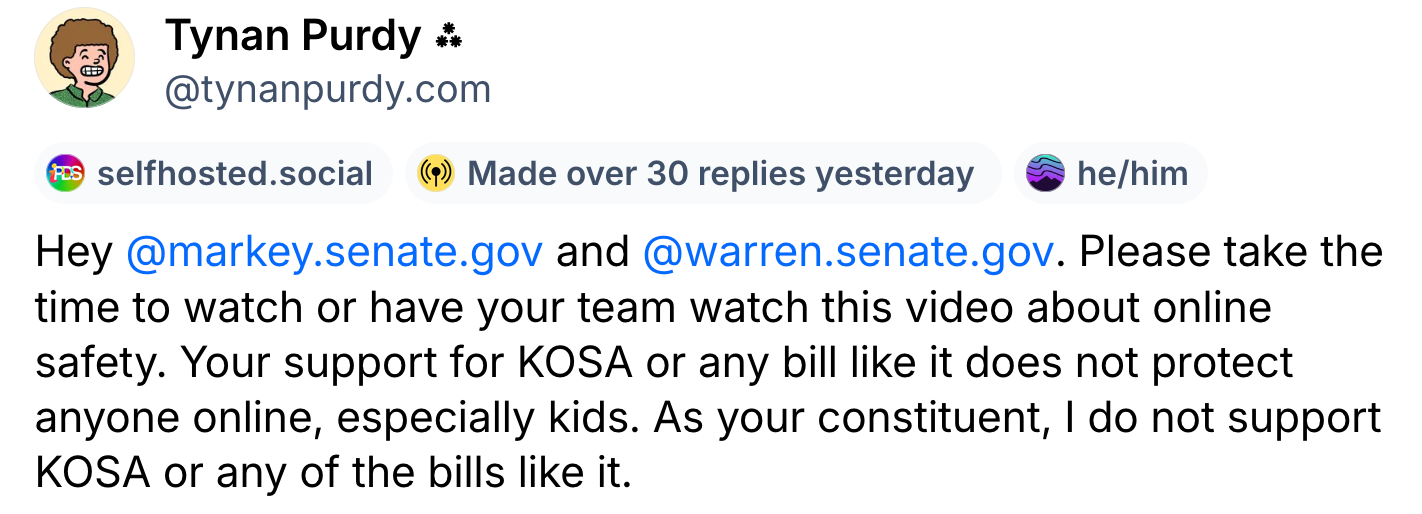
Tagging or replying to legislators on social networks is a useful complement to contacting them through official channels. Phone calls and emails count for more, and there's no guarantee they'll read all the posts. Still, i Senators (or more accurately somebody in their comms team) typically track the number of interactions with their accounts and run sentiment analysis, so they'll notice if they start getting a lot of comments about bad internet bills. And these posts are public, so other people might see them and join in as well.
If you're in the ATmosphere, Tell Senators with Bluesky accounts what you think about KOSA and other bad internet bills. If you're in the fediverses, as far as I know your out of luck on this one so far – there aren't any US Senators with accounts in the fediverses.
Update, August 12
The Washington Privacy Organizers post to Cantwell got a couple of dozen reshares, and inspired at least one other person to make a similar post ... not bad for a first attempt. I also saw several other posts from people tagging their Senators, so other people also think this is a useful tactic (although probably came up with the idea on their own). So, more experimentation is clearly needed, but a potentially useful direction.
In the fediverses: how can we leverage locally-based US instances?
Geographically-based, relatively-small fediverse instances like pnw.zone, gardenstate.social, sfba.social, jawns.club, hoosier.social, dmv.community, etc are in principle a great match for this kind of activism. The short Washington Privacy Organizers' thread on pnw.zone, for example, includes a direct link to Senator Cantwell's contact form, and context about her role on the committee. The local feed on pnw.zone is relatively quiet, so anybody who checks it is likely to see it. And if people on other Washington-based instances like social.seattle.wa.us amplify it as well, it could get traction there too.
Are there ways to leverage these locally-based instances more effectively? Good question. Here's a thread asking for ideas. Your thoughts welcome!
Update, August 12
I didn't get any responses to that thread. And, a similar post about getting Canadian instances involved in the fight against C-34 also didn't get any responses. Oh well.
Interestingly, while Washington Privacy Organizers' pnw.zone post later that week on a more locally-focused issue (Seattle's surveillance pricing ordinance) got a fair amount of traction, only one boost came from a geographically-focused instance. One way to look at this is that it really highlights the opportunities for improvement!
To be continued!
The ideas here are just a starting point for what we can do in response to KOSA and the other bad internet bills in Congress. At the risk of sounding like a broken record, other suggestions welcome!
There are plenty of important battles over bad internet bills happening in states across the US as well as in Congress – including Massachusetts' social media bill, California's social media ban A.B. 1709. And there are plenty of bad internet bills in other countries as well. And how to adapt the US-focused tactics I've described above to these other situations?
I certainly don't have the answers here ... but I'm sure that others have ideas!
It'll be interesting to see how things play out over the next few days. After the vote, I'll follow up with reflections on what went well and what we learned, as well as thoughts about how similar tactics can apply to state-level battles and other countries. After that I'll look in more detail about activism pushing back against Flock and other ALPRs.
Update, August 12: After-action reflections
"Wow, I wasn’t expecting that! After the Senate Commerce Committee‘s roll-call vote on the odious SCREEN Act age verification bill (15-13 along party lines), Ranking Member Cantwell casually mentioned that there weren’t enough members present in person. Chair Cruz agreed, and noted that as a result the bill would not be reported out. And then the committee went on to other bills, including KOSA (the Kids Online Surveillance Act) and the CHATBOT Act, advanced them all on voice votes, gave a few speeches, and the hearing was done....
From an organizing perspective, it was also a good learning experience.... All in all, a good result!"
– Activism makes a difference: the SCREEN Act unexpectedly fails in committee! But KOSA advances, so keep up the pressure, August 5
From a legislative perspective, this committee hearing set the stage for a potential Senate floor vote in September on a "kids safety" package including KOSA and several other bad internet bills. The good news is that it probably won't include the SCREEN Act, and opposition to KOSA was loud enough that if we keep up the pressure we have a good chance to block it. So we shall see.
From an organizing perspective, it was a great opportunity to calibrate where we are today, test assumptions, and look for strengths to leverage as well as areas where improvement is needed. In general, I feel like this skirmish really confirmed the potential for major impact on bad internet bills in the US, and probably elsewhere as well, although also highlighted some challenges that need to be addressed. The notes in the various sections above have some initial thoughts about that, and a follow-on post will go into more detail – and also look at next steps on bad internet bills.
Speaking of which, evenj though Congress is on recess for the next few weeks, it's if you're in the US, it'sstill useful to give your Senators a call or send them an email to remind them that you want them to vote against KOSA and other bad interent bills. EFF's Tell the Senate: Don't Turn the Internet Into an ID Checkpoint and Fight for the Future's Bad Internet Bills make it easy, and Tips for contacting Congress about bad internet bills has other options as well.
Please discuss – and stay tuned for more!
And please continue the discussion – about fighting bad internet bills, and more generally organizing against the surveillance-industrial complex in the ATmosphere and fediverses.
- The Polis conversation here is the easiest way to share your thoughts and give feedback on what others are saying.
- In the ATmosphere, the thread on blacksky.community is also accessible via mu.social, Bluesky, and other apps. There's also a more-general discussion on discourse.atmosphere.community, focuses on the tools and technologies for organizing.
- In the fediverses, the thread on gotosocial.thenexus.today is also accessible from most other fediverse platforms. There's also an earlier brainstorming thread with some additional ideas.
To see upcoming posts, you can follow @nexusofprivacy.net, @nexusofprivacy@gotosocial.thenexus.today, @thenexusofprivacy@lemmy.blahaj.zone and/or subscribe to the Nexus of Privacy newsletter